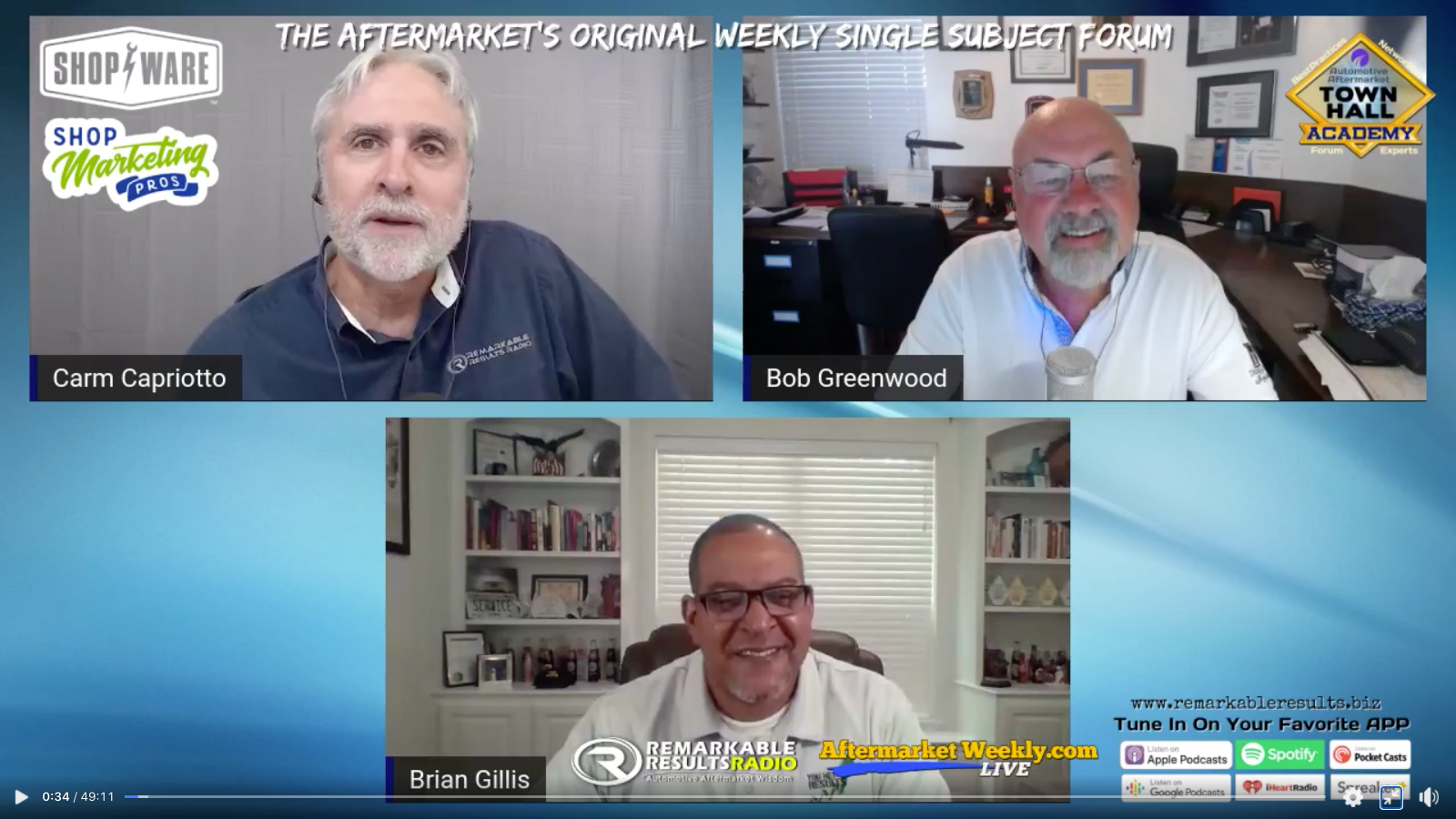
Our chief strategist Brian Gillis recently made a return appearance on the Town Hall Academy podcast. This time on the automotive industry standard show, Brian discusses how to create and execute procedures and systems (SOP’s) for your shop. If you need to get organized and create your shop’s how-to manual, then this episode is for you!
Systems and processes podcast discussion
First of all, Brian gives host Carm Capriotto the low down on how to get started with SOPs. If you start out by organizing the systems you will need to run your business smoothly, that will save you headaches later on. Starting with the basic “SOP on how to create an SOP” will be a valuable to resource for you and your staff when you need to write new systems. Create a template with the key questions (how, what, when, where, why, and how) that the SOP will answer for your business. Store all of your documents in either Dropbox or Google Drive. Then link all of your team members up to them for quick access.
Brian and Carm then go through a sample system, the Incoming Phone Call SOP. This process details who needs to answer the phone, as well as scripts they can use, depending on the customer’s needs.
Why are SOPs so important? Staff turnover is inevitable. Easily accessible documents can help both new recruits and employees changing positions to quickly learn. When your staff members know how to do tasks consistently, they improve their value. Down the line, this will also increase your business’s value to clients and potential investors.
This is how we do it! Get buy-in from your staff on documenting the systems and processes. Well defined and organized SOPs are the first step to create a culture of success and efficiency in your shop.
Interested In Learning More About Our Services?
Organized systems are crucial to a successful automotive business. You Net Results is a coaching group that helps you navigate and apply these processes. Why not schedule a FREE business strategy session with Brian? You’ve got nothing to lose, so sign up today!
Are you an auto repair General Manager who struggles with confidence issues? Then you must watch this clip from our members only General Manager Process! Our host Brian Gillis asks the round table of automotive shop managers what being a confident leader means to each of them.
General Managers sound off on what it takes to make a confident leader
First, Brian calls on veteran shop owner Jerry Kaminski. Jerry jumps right in, asserting that both owners and managers must continually examine and refine their systems. Our friend Leon then adds that regular training sessions with a coaching group are crucial. Jim expands on that point that your group must be made up of like minded people who are just as passionate about the automotive industry as you are. If all parties are dedicated to studying and improving, then you will benefit from the time you have invested.
Edward, a successful Midas owner, chimes in to say that a confident leader must trust their own knowledge, as well as their shop’s processes. General Managers must ensure that all of their team members are consistently executing their processes and procedures. Following up is key.
Andy Arndt then reviews our company’s mission statement on helping general managers. Here at You Net Results, we are committed to teaching repair shop owners and managers how to become fearless. Jim then continues by reminding the class of our 25+ years of automotive industry experience. We work with individual general managers in order to help them define what success means to them. Then, we step by step help them to reach those goals.
Finally, Brian reviews. He stresses the importance of surrounding yourself with the right staff, as well as encouraging them to learn and implement the right systems.
Recently, our own Brian Gillis appeared on the Remarkable Results Radio podcast Town Hall Academy. This show features a roundtable discussion amongst automotive industry experts on a single topic. Carm Capriotto and Bob Greenwood discussed all of the ins and outs of labor rates with Brian on this special episode.
Labor Rates podcast discussion
Brian elaborates that shop owners want to look at the end goal result first. Shop owners must first know the true cost of doing business in order to arrive at their labor rate formula. In fact, as Bob states, it is important for you to employ not one, but at least three labor rate formulas. Today’s automotive industry is more diverse than ever. Thus, you need employ different rate formulas for maintenance, diagnostic, and reflash.
Bob then presents the cost per billed hour (CPBH) formula. Every dollar must have a name, and every expense needs to be accounted for in order to know rates that are right for your shop. Finally, you should net 20% of gross sales after paying yourself (first!) and your employees a professional wage.
Brian and Cam reiterated that you are in the labor business! Therefore, you must give special attention to your team’s rates. Bob then gave examples of the three door rates he mentioned earlier. He presented formulas for setting those door rates, which are based on competency rate and/or efficiency of business operation.
After discussing these key stats, Brian discusses the concept of labor matrixes, specifically accurately charging for the time that’s spent. Then, the hosts welcome shop owner Bill Nalu to discuss the emotional aspects that go along with the numbers. Courage, as well as knowing your worth as a technician, are essential.
This all may seem complicated, but you can do it! You Net Results is here to help! Why not schedule a FREE business strategy session with Brian? You’ve got nothing to lose, so sign up today!
You have heard us speak about silent thieves before. You Net Results’ game plan starts with helping your auto repair shop identify which thief or thieves lurk in your midst. In this clip from our Daily Operations meeting, Brian quizzes members on their own experiences. Is your auto shop losing money, but you don’t know why? Then watch this video and find out!
Auto shop losing money – silent thieves on the prowl
Brian opens up by explaining the concept of a silent thief, which is money leaking out of your shop undetected. He asks members what those thieves look like in their shops, starting with inventory.
Once Andy’s business started growing, he noticed that he started to lose track of inventory. His shop’s process of transporting waste oil for reuse, for instance, needed improvement. Therefore, he bit the bullet and invested in new equipment.
Joe’s parts were not properly being charged out, so he implemented a new process to keep track of this expense.
Then, Jim talks about the priorities of owners and managers. Whenever the boss doesn’t manage time well, silent thieves can creep in.
Next up, Leon mentions labor inventory. In his case, this is a huge chance to lose money. Because it can be hard to keep track of, labor rates may be a shop’s #1 money loser.
Finally, Brian discusses one thief we may not have thought of previously. Let’s say our advertising is on point, and customers are jamming your phone lines. If your service writers don’t know what to say to them to close the sale, then you may as well be throwing money out the window. This is why proper phone skills and scripts are crucial.
A few tidbits discussed afterward revealed the importance of taking notes on procedures, as well as being open to change. Surprisingly, many shop owners still use pen and paper instead of computers to keep up with shop supplies and tickets. Doubtless, these shops must update procedures and conquer their fear of change in order to survive.
Stop your silent thieves!
Do these problems sound familiar to you? By now, you might be wondering how you can solve these problems. We have your answer! Try one of our coaching groups for free. Each week, you can join fellow shop owners to identify your problems. Then, apply our systems to start turning record profits!
The automotive repair industry comprises a variety of distinct positions. Check out this this short clip from our members only People Process workshop. Brian Gillis and the callers explain automotive jobs. The You Net Results group members outline both the jobs’ tasks and their relationships to each other. Each shop owner on the call shares their knowledge from decades of adapting to an ever changing industry. Do you think you know everything about each job description in the automotive field? These pros all bring up some great points that you may have never considered. Don’t miss out! Watch this clip now.
Explain automotive jobs: Owner and General Manager
First, Brian asks members what it means to be an automotive repair shop owner. Andy recalls his experience working his way up to the position of Owner of his own family’s repair business. He describes “replacing himself” by delegating tasks to other staff members. Sometimes it does not work out immediately. In those instances, he needs to resume said chores temporarily. The bottom line is that owners have to wear many hats within the auto repair business, thus they need to stay on their toes to adapt to change.
Jim chimes in to describe a General Manager is responsibilities. He or she also must delegate jobs amongst the team. However, the GM is often on the floor, right in the action. Thinking on your feet is the key principle! Managers may assist with tickets, tracking parts inventory, and weekly organizational tasks for both the front and back of house staff. Sometimes, perhaps most importantly, they are the face of the shop to customers.
Your GM may need to engage clients in “show and tell” about the repair process, or grab them a cup of coffee. A great General Manager is willing to do anything to make your customers feel welcome! This important position is very challenging, but the more dedicated and flexible you are, the more rewarding it can be!
Explain automotive jobs: Front Counter Staff
Explain automotive jobs: Your Front Counter Staff, or Service Advisors, are crucial!
Whether you call it Front Counter Staff, Service Advisor, or Service Writer, this job is a crucial spoke in the automotive shop wheel. Cory explains what this job means to him, since he has experience with training his own front counter staff.
Service Advisors are the conduit between both your customers and your mechanics. They’re responsible for explaining the car’s repair needs to customers. They also must estimate how long repairs will take and how much they will cost.
“Job stacking” is a critical task for a Service Writer. Managing multiple jobs can be tough, so Front Counter Staff need to have excellent time management and organizational skills. Not to mention, they must work with vendors in order to ensure all necessary parts are in stock. The COVID-19 pandemic presented new challenges to these workers, such as online communication with customers, due to social distancing requirements.
Cory believes that no other position is as integral to an auto repair shop’s income stream than the Service Advisor. You could say that no other auto repair position requires people skills more than that of a Service Writer.
What are the responsibilities of General Service Technicians?
When we explain automotive jobs, we must not leave out the General Service Technician – the heartbeat of your shop!
A General Service Technician is sometimes called a Mechanic by a lay person. It is undoubtedly the heartbeat of any auto repair shop. Techs often perform a thankless job. That is despite the fact that they are required to take regular ASE certification training.
While many facets of the auto repair process don’t change, technology advances dictate their continuing education. Who knows, your shop may have to service a self driving car in the very near future! Mechanics need to know everything from transmission repair to how to fix the computerized engines of 21st century cars and trucks.
Joe is a veteran shop owner who hails from the state of Alabama. He has seen it all in his day! First of all, Joe runs down the ever evolving responsibilities of technicians. He then recalls his own experiences as a mechanic, which began over 50 years ago. Before they engage in continued learning, each tech must have a strong foundation of general know how. Speed of service is also a crucial factor for technicians.
Mechanics are typically the lowest paid team members, but they have plenty of opportunities to advance their careers. General Service Technicians can learn many skills on the job. Whether at their existing shop, or in another industry, they can be valuable hires. Their communication with others in house, plus their flexibility, are important traits. Those skills can help a General Service Tech to eventually move up to an A Tech, Service Writer, or even Owner position over time.
Ready to learn more? Grow your shop’s bottom line with our weekly meetings!
Are staff relationships and automotive repair training confusing you? Do you struggle to put all of the pieces together? Then why not join one of our monthly coaching groups! You will gain instant access to join our live weekly Zoom meetings. These calls cover topics such as budgeting for profit, hiring, leadership, and much more. Members also have 24/7 access to countless hours of previous training calls, plus a library of valuable documents will help to guide you. Sign up today!